
Precautions in the Processing of Stainless Steel Deep Drawing Parts
Stainless steel deep drawing parts, as precision components in industrial manufacturing, undergo a dual test of precise design and rigorous manufacturing during their creation process. On the production line, they undergo a series of complex and delicate processes such as cutting, stamping, and deep drawing, gradually taking shape as warriors forged through countless trials, exhibiting a combination of toughness and delicacy.
However, in this magnificent transformation, even the slightest operational error can become a stumbling block on their path to perfection. If there is a slight deviation in the die design or improper control of the stamping pressure during the stamping process, it’s like carving unnecessary marks on a delicate surface, leading to worrying cracks on the surface of the stainless steel stamped parts. These cracks not only damage the original aesthetics and integrity of the product but also subtly weaken its mechanical properties and corrosion resistance, rendering it unable to meet the intended usage requirements and ultimately, regrettably, labeling it “unqualified.”
Hence, meticulous attention is required in every operation involved in strict control over each process. This is essential to guarantee that every product impeccable condition, contributing. The creativity and expertise passed down by each craftsman play a crucial role in this endeavor, serving as protectors who skillfully outfit stainless steel deep drawing parts with impenetrable armor.
Causes of Cracking in Stainless Steel Deep Drawn Parts
- Excessive local deep drawing pressure during processing: Stainless steel deep drawn parts are subject to both internal and external pressure, leading to localized deformation or cracking.
- Improper die adjustment during the forming process: Technicians failing to adjust the die according to specified data results in unstable die operation, also causing cracking of the stamped parts.
- Problems with the die design: There are problems in the design of the deep draw mold. The structural conditions of the mold, such as large stroke and small blank pressing area, can also lead to cracking.
How to Prevent Common Cracking During Production
- During the production of stainless steel deep drawn parts, the contact area between the punch and the blank should be maximized, and the blank should be pressed reasonably to ensure uniform stress on the material.
- When designing structure of deep drawing dies, the shape should be as simple as possible, with gentle changes and uniform depth.
- Operators should receive skills training to improve their operational skills and avoid human error.
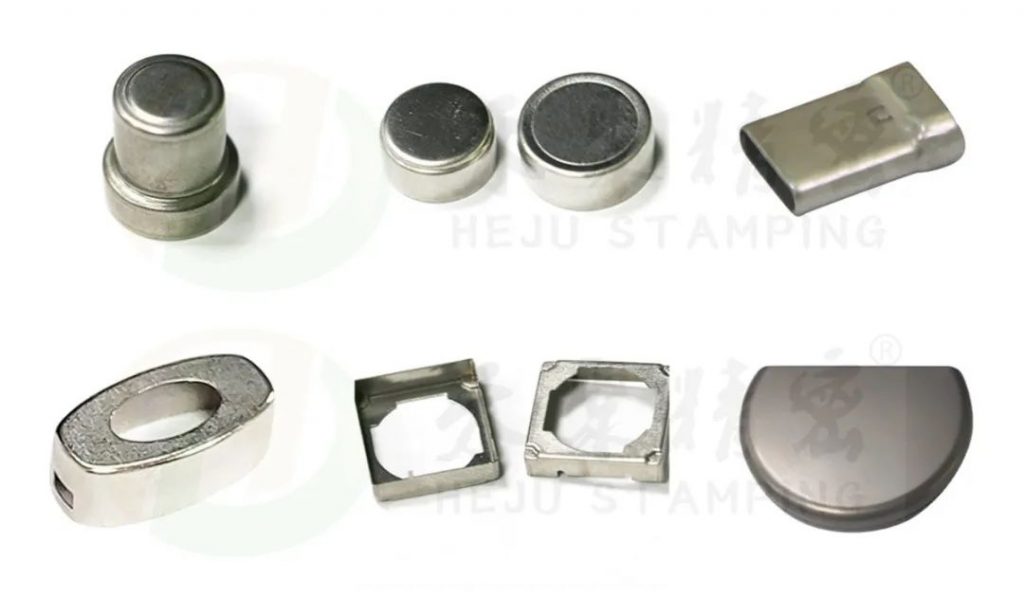
The production of deep drawn stamping parts requires the use of various materials. Today, let’s talk about stainless steel as one of the raw materials. Stainless steel deep drawing stamping parts can be used in various industries. Its advantages are that it is not easy to rust and has a more beautiful surface. What issues should we pay attention to in production?
When the quality and dimensional accuracy of the cross-section of stainless steel stamping parts are required to be high during the production process, consider using a more precisely designed die or adding a shaping process after the stamping process to meet the process requirements.
The complexity of the part’s structural shape largely determines the number of bends required, with die design tailored to the specific bending angle of the stainless steel component. In cases involving intricate designs, multiple forming processes may be needed, whereas simpler configurations can often be accommodated within a single cavity.
For deep drawn stampings, the interplay between the number of processes, drawing height, and material thickness is critical, necessitating precise calculations to inform production decisions and often requiring a reshaping step to ensure conformity to specifications.
But for relatively simple stamping parts, it is advisable to choose single-process molds. For stainless steel stamping parts with complex shapes, the mold structure is prone to limitations and needs to be completed through multiple processes. If necessary, continuous molds can be used for production.