
How do Precision Metal Stamping Dies Work?
In the industrial manufacturing sector, stamping dies are the core tools for forming metal parts. They apply external force to metal sheets using a press, causing plastic deformation within the die cavity to ultimately obtain the part shape that meets design requirements. These stamping dies are widely used in industries such as electronics, automobiles, and home appliances, undertaking the task of mass-producing standardized hardware parts. Their precision and durability directly affect product quality and production efficiency.
Technical Principles and Structural Composition
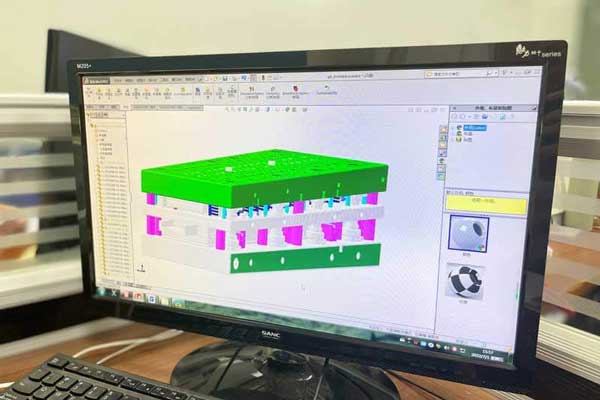
The core principle of precision stamping dies is to utilize the cooperation of a punch and a die, driven by a press, to separate or form sheet metal. Its structure typically includes components such as an upper die holder, a punch, a stripper plate, a die, and a lower die holder. The punch is responsible for the stamping action, the die provides the forming cavity, and the stripper plate ensures the material smoothly exits the die after stamping. Die steel is the main material, requiring high hardness, wear resistance, and fatigue resistance to withstand long-term, high-intensity stamping operations. A rust-preventive oil coating is used for surface treatment, effectively extending the die’s service life and reducing downtime for maintenance.
Processing Method and Customization Process
Wire EDM is a key processing technology that achieves micron-level precision cutting through pulsed discharge between the electrode wire and the workpiece. This process can handle complex cavity structures, ensuring mold dimensional accuracy within ±0.005mm. The customization process typically begins with customer-provided drawings or samples. Engineers conduct structural analysis, material selection, and process planning, followed by CNC programming before entering the wire EDM stage. Subsequent processes include heat treatment, precision grinding, assembly, and debugging, culminating in a trial molding test to verify the forming effect. The entire process strictly adheres to the ISO quality management system to ensure stable mold performance.
Application Scenarios and Technological Advantages
These metal stamping molds primarily serve the forming needs of various hardware components, including precision parts such as terminals, connectors, hinges, and brackets. Compared to traditional casting or machining methods, stamping offers advantages such as high material utilization (up to 90% or more), high production efficiency (dozens of stampings per minute), and good dimensional consistency. The mold steel material, combined with rust-proofing treatment, allows it to withstand high-intensity operating environments such as progressive dies and continuous dies. The sky-blue coating not only enhances visual visibility but also facilitates mold management on the production floor.
Heju Stamping-Precision Progressive Metal Stamping Dies Manufacturer
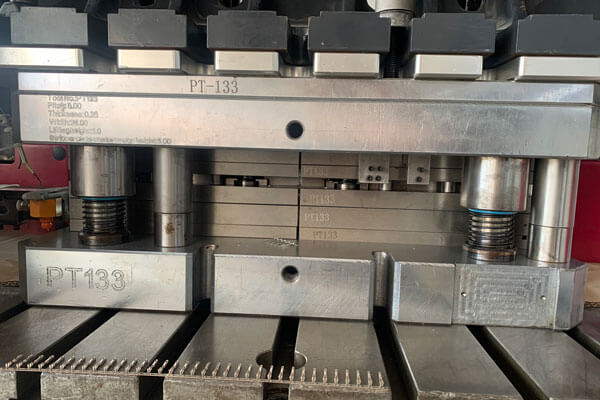
Heju Precision has been deeply involved in the precision metal stamping field for many years. Focusing on providing high-precision, high-difficulty electronic stamping parts and integrated precision metal stamping dies solutions for automotive connectors, new energy battery structural components, gas sensors, micro linear motors, chip packaging and testing, and medical device components (consumables). From initial analysis to 3D modeling, and Simulation verification then optimization, all processes are self-designed. The tooling with ±0.002mm accuracy sets the benchmark for downstream processes — ensuring consistency, stability, and scalability across complex components. Equipped with world-class processing facilities, including Western wire cutting machines, oil cutting machines, PG machines, and a series of other high-precision processing facilities, ensuring consistency, stability, and scalability across complex components. Our progressive toolings have been widely exported to European, American and Southeast Asia markets, highly recognized by clients.