
How to Choose a Sensor Housing? Plastic vs. Aluminum Alloy vs. Stainless Steel
The sensor housing is the “first line of defense” protecting the sensor and safeguarding its internal precision components, directly determining the sensor’s stability, lifespan, and applicable scenarios. Choosing the wrong material can lead to signal malfunctions and frequent repairs, or even complete failure of the sensor and increased costs.
The mainstream materials for sensor housings on the market are plastic, aluminum alloy, and stainless steel. These three materials differ significantly in cost, performance, and applicable scenarios. To avoid making a mistake when choosing a sensor, this article will break down the core characteristics of these three materials in detail to help you accurately match your needs.
Comparison of Core Performance of Three Materials
Engineering Plastics (ABS/PC/PA66)
♦Advantages: Lowest cost, lightweight, good insulation, fast injection molding, resistant to common acid and alkali corrosion, suitable for mass production at low cost.
♦Disadvantages: Ordinary plastics have relatively low strength, are not resistant to high temperatures, are prone to aging, and are easily brittle at low temperatures; however, high-performance engineering plastics (such as PC, PA66) can withstand temperatures ranging from -40℃ to 120℃. In addition, plastics have poor heat dissipation and lack electromagnetic shielding capabilities.
♦Applicable Scenarios: Indoor consumer electronics, general environmental monitoring sensors, projects that are weight-sensitive and have limited budgets.
Aluminum alloy (6061/7075)
♦Advantages: Lightweight (density only 1/3 that of stainless steel), excellent heat dissipation, superior strength compared to plastics, improved corrosion resistance after anodizing, and shields against electromagnetic interference.
♦Disadvantages: Moderate corrosion resistance; not resistant to strong acids, alkalis, or high salt spray; prone to deformation under prolonged exposure to temperatures exceeding 200°C.
♦Suitable Applications: Automotive electronics, lightweight equipment, general industrial sensors, and applications requiring a balance between weight and heat dissipation.
Stainless steel (304/316L)
♦Advantages: High strength, excellent corrosion resistance, high and low temperature resistance, anti-aging properties, strong electromagnetic shielding; 316L stainless steel is resistant to seawater, salt spray, and most common acids and alkalis.
♦Disadvantages: Heavy weight, high cost, and difficult processing; stamping/CNC machining costs are higher than the previous two materials.
♦Suitable Applications: Sensors in harsh environments such as chemical, marine, food, pharmaceutical, and extreme high and low temperature environments, where stability and lifespan are extremely important.
Key Selection Criteria: Precise Matching Based on Scenario
General indoor use: low cost, and high-volume production: prioritize plastics to control costs and meet basic protection requirements.
Lightweight applications requiring heat dissipation and general industrial use: choose aluminum alloys to balance performance and cost.
For high corrosion, strong vibration, and extreme environments: stainless steel is essential to ensure long-term stable operation.
Pitfalls to Avoid
Don’t just focus on material costs; consider the maintenance costs resulting from factors like processing precision, sealing, and durability. Inferior housings are prone to sealing failures, material deformation, and signal interference, ultimately increasing rework and replacement costs.
The core of a sensor housing is “suitability for the application scenario + stability and reliability.” Choosing the right material is only the first step; the more crucial factor is finding a professional supplier with excellent craftsmanship and strong customization capabilities.
HejuStamping-Reliable Sensor Housing Stamping Manufacturer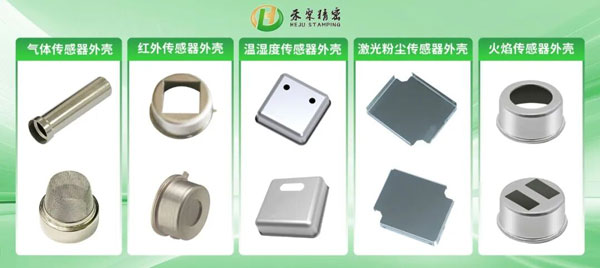
Dongguan Heju Precision Electronics Technology Co., Ltd. has been deeply involved in the field of sensor housing stamping for over ten years, specializing in precision stamping of stainless steel, aluminum alloy, and other metal housings, covering the customization of housings for all categories of sensors, including temperature, gas, and infrared sensors. We provide one-stop service from design to mass production, committed to providing customers with cost-effective housing solutions suitable for complex scenarios through mature processes and large-scale production.