
Comprehensive Analysis of COC Fishbone Fixtures in Burn-in System
The COC fishbone fixtures in Burn-in System, with its fishbone array-like design, integrates positioning slots, beryllium copper elastic contact springs, and thermally conductive trenches. It is a key high-value consumable in the production and testing of optical modules, primarily used for burn-in tests of optical chips. Its core function is to provide precise positioning, stable power application, and environmental simulation for the optical chips, ensuring testing accuracy and production line efficiency.
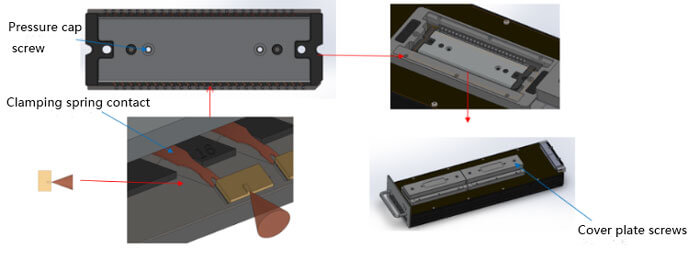
Why do Optical Chip Production Lines Generally Use COC Fishbone Fixtures/Clamps?
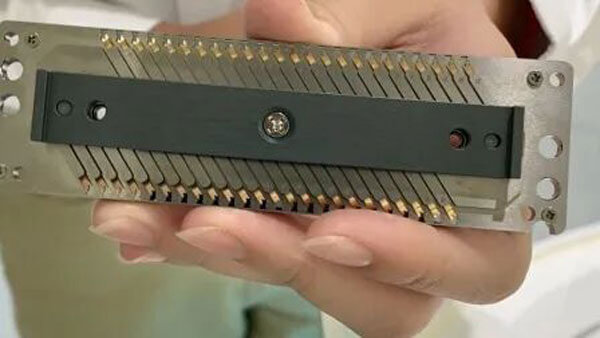
♦ Precise Damage Prevention: Independent elastic springs apply pressure evenly at multiple points, ensuring uniform force distribution and preventing chip deformation, edge chipping, and plating damage;
♦ Process Compatibility: One-stop adaptation for the entire process of wire bonding, room temperature testing, high-temperature aging, and retesting. Automated production lines reduce multiple material transfers and fixture changes;
♦ High-Efficiency Mass Production: Simultaneously adaptable to manual sample production and automated equipment, catering to both small-batch R&D and large-scale mass production needs;
♦ Strong Stability: Wide temperature control adaptation range, less prone to deformation and displacement under high-temperature aging conditions, reducing test data errors;
♦ Wide Versatility: Supports customized adaptation to different sizes of COC and CoS carriers; some customized solutions are compatible with specific TO-type device testing.
Which Fields Require COC Fishbone Fixtures?
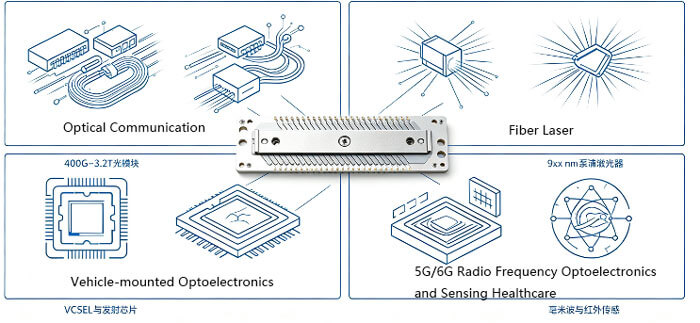
◊ High-speed optical communication: Adapted to 400G~3.2T high-speed optical modules for AI data centers, meeting the mass production and high-temperature aging testing needs of various high-speed optical chips such as DFB, EML, and SOA.
◊ Fiber laser and industrial pumping: Adapted to 9xxnm high-power pump lasers, designed for 500mA+ high-current operation, with thickened beryllium copper spring sheets for effective arc resistance and ablation prevention, suitable for large-scale mass production testing.
◊ Automotive optoelectronics and LiDAR: Adapted to automotive VCSELs and LiDAR emitting chips, meeting the stringent testing requirements of wide-temperature range, vibration resistance, and miniaturization in automotive scenarios.
◊ 5G/6G communication and medical sensing: Widely used for semi-finished product testing and quality inspection of precision devices such as 5G/6G millimeter-wave optoelectronic components, infrared sensor chips, and medical endoscope light sources.
Which Process Scenarios Use Fishbone Fixtures?
Die Bonding/Eutectic Bonding Carriers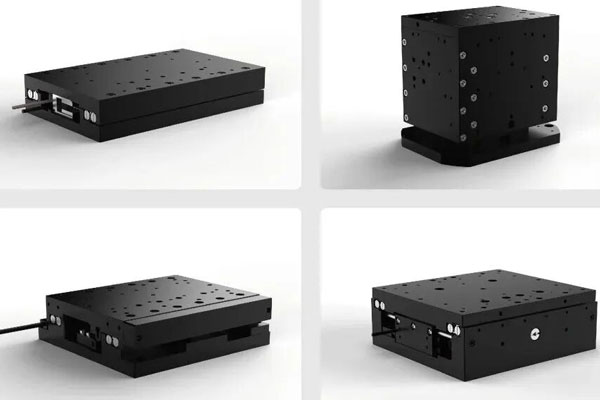
♦ Applicable Equipment: High-precision eutectic bonding machines, die bonders
♦ Purpose: Herringbone fixtures can handle the transfer of ceramic substrates after eutectic bonding; some customized versions can be directly compatible with high-precision eutectic/die bonding stations, ensuring consistent substrate positioning;
♦ Adapters: DFB, EML, SOA, tunable laser semi-finished product carriers
♦ Core Value: Prevents bare substrates from scattering and colliding during transfer, while utilizing the fixture’s global positioning reference to improve the overall consistency of eutectic bonding.
Gold Wire Bonding (Wire Soldering) Station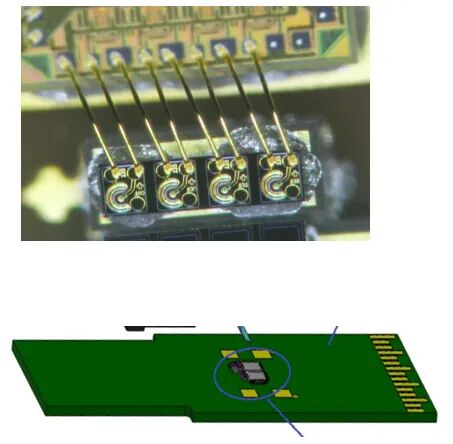
♦ Applicable Equipment: Fully Automatic Gold Ball Bonding Machine
♦ Key Features: The herringbone fixture has pre-drilled slots to allow for direct downward insertion of the wire bonding cutter. Coated wire (COC) can be directly bonded on the fixture without removal. The fixture’s upper surface height matches the cutter’s safe stroke, and space is provided to avoid ultrasonic vibration, mitigating the risk of wire arc collapse and pin collision during deep cavity bonding.
♦ Core Value: Solves the positioning misalignment problem of traditional independent tray wire bonding, relying on the herringbone array for limiting and ensuring multi-channel bonding consistency, saving time on repeated loading and unloading and fixture changes.
Room Temperature LIV Photoelectric Performance Testing (Initial Test)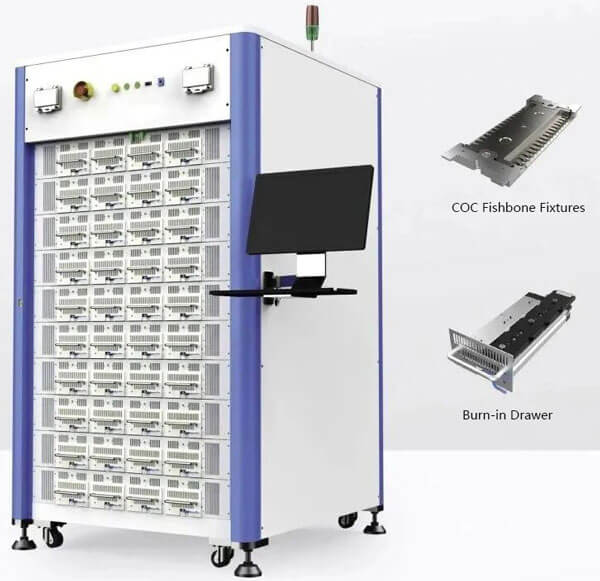
♦ Equipment: COC Automatic Test Stand, Magazine-Type Probe Tester
♦ Method: Beryllium copper spring contacts the positive and negative electrodes of the COC vertically, providing a stable output drive current; simultaneously acquiring key parameters such as optical power, threshold current (Ith), spectrum, and side-mode rejection ratio (SMSR).
♦ Value: Immediate initial screening after wire bonding, preemptively removing open-circuit, short-circuit, and photoelectrically defective products, preventing defective products from entering subsequent high-cost processes.
High-Temperature Aging Screening (Core Scenarios for Mass Production)
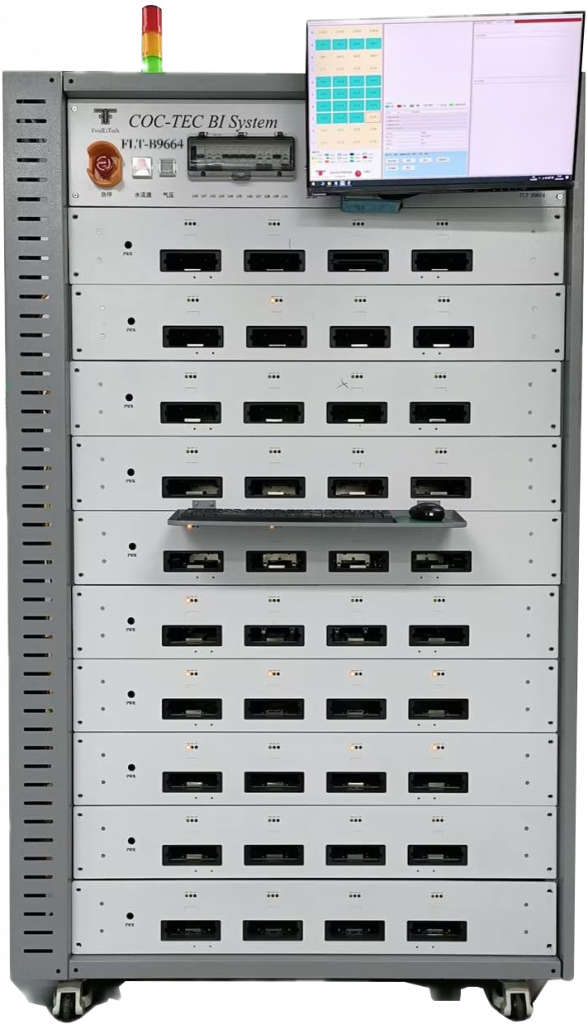
♦ Equipment: Drawer-type COC Aging System
♦ Operating Conditions: Continuous energization at 60~100℃ accelerates aging and screens for early-failure components.
♦ Structural Value:
- Herringbone-shaped perforated heat-conducting grooves ensure full contact between the bottom of the COC and the heat sink, combined with uniform airflow in the aging furnace, achieving temperature uniformity of ±1~2℃ (depending on furnace performance);
- Beryllium copper spring contacts are high-temperature resistant, have low contact resistance, generate minimal heat during prolonged energization, and exhibit low stress relaxation rate at high temperatures, preventing deformation and loosening;
- High-density array, a single fixture can accommodate 32/48/64 channels of COC, significantly increasing aging capacity.
Post-Aging Retest (Final Test)
♦ Working Method: After aging, the entire tray is directly transferred to the retest station for a second scan of LIV and spectrum, comparing parameter drift before and after aging.
♦ Core Value: No re-clamping required, avoiding secondary positioning errors, ensuring data comparability before and after aging, accurately determining device qualification, and allowing qualified products to directly proceed to the coupling and packaging process.
Pre-Coupling Transfer Storage/Automatic Loading and Unloading
♦ Supporting Method: Magazine machine, silo storage, and closed-loop transfer in a cleanroom.
♦ Core Value: The standardized shape of the herringbone fixture is compatible with automated magazine loading and unloading, while effectively preventing dust and oxidation on the COC chip surface during clean transport, ensuring high coupling yield.
Hejustamping-Your Faithfully COC Fishbone Fixtures in Burn-in System Supplier
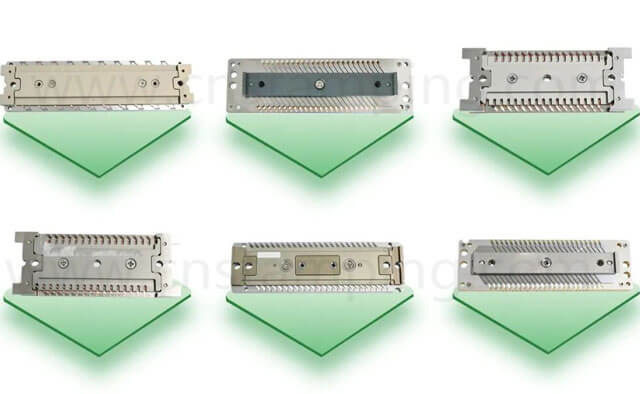
As a high-tech enterprise specializing in the R&D, design, and mass production of COC fishbone fixtures in burn-in system, Heju Precision’s self-developed COC fishbone fixture boasts mature technology and stable quality control. Relying on 8years of mass production experience in supplying beryllium copper spring sheets to Huawei, it features outstanding high-temperature thermal conductivity and clamping performance.
It is precisely matched to the harsh working conditions of long-term power-on aging tests for optical communication lasers, perfectly solving industry pain points such as poor heat dissipation, cumbersome assembly, high maintenance costs, long delivery cycles, and weak equipment compatibility of traditional fixtures. With its precision manufacturing capabilities, it provides reliable support for optical communication chip manufacturers to efficiently complete quality screening and control chip yield. Contact us for your burn-in testing project.