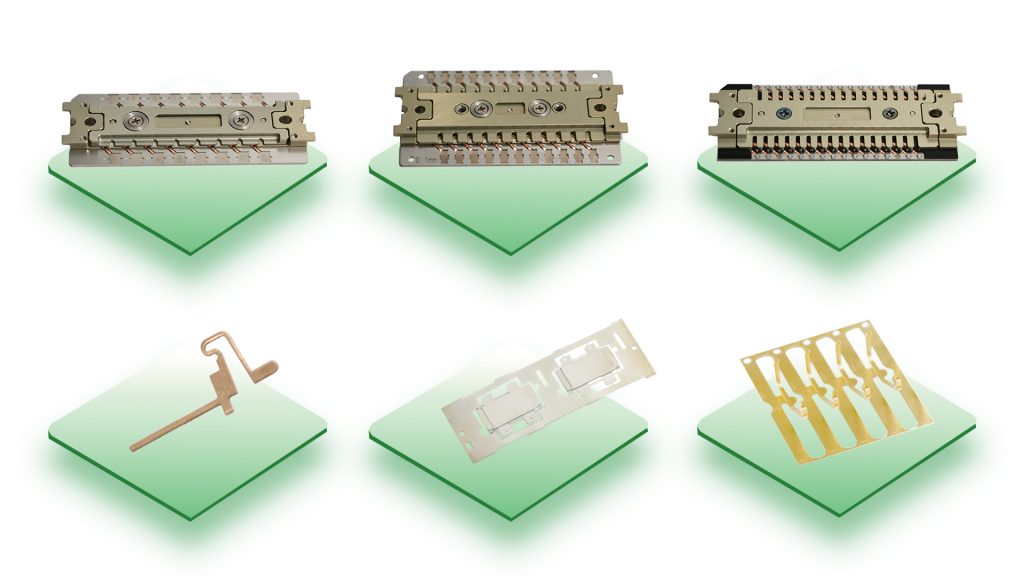
COC Burn‑In Fishbone Fixtures: How They Supercharge Chip Reliability Screening
Let me draw you a picture. You’ve just finished a run of high-power laser diodes. You send them to burn-inin testing — 24 hours at 85°C with a constant current — and when they come out, half of them have degraded. Not because the chips are bad, but because your socket killed them. Poor contact. Uneven temperature. What’s worse, a wire-bonded COC (Chip-on-Carrier) that got cracked during loading because the clamp was too aggressive.
At this point, the fishbone-shaped fixture comes in handy. But what makes it so special for burn-in? And why are so many test houses ditching legacy sockets for this fishbone-shaped design? In this article, we will learn more about it, from the physics of aging to the real-world world headaches that fishbone fixtures actually solve.
What Exactly Is a COC? Why Does It Need Burn-In?
COC stands for Chip on Carrier. Instead of packaging a laser or photodiode into a bulky TO-can or butterfly housing, you mount the bare die onto a small ceramic or silicon submount. This submount has patterned electrodes that fan out from the tiny bond pads, making it easier to test and handle.
However, COCs are fragile, small, and highly sensitive to temperature and current. They’re also expensive to assemble, so you cannot afford to screen out good dies due to fixture induced failures.
Burn-in (or aging) is a necessary reliability screening step. You stress the chip at elevated temperature(typically 24 to 1000 hours) and nominal operating current for a set duration. This accelerates early failures (infant mortality) and helps you separate the robust parts from the fragile ones. For automotive or telecom-grade lasers, zer0 defect is the only acceptable outcome.
So the test fixture has to deliver three non-negotiable things:
1. Stable, low-resistance electrical contact for the entire burn?in duration.
2. Excellent thermal coupling–because the chip’s junction temperature must stay accurate;
3. Gentle but secure mechanical handling.
Traditional sockets such as pogo-pin arrays, elastomeric connectors, or homemade wire? bond boards are easy to fall short on at least one of these. That’s why fishbone fixtures were developed.
What Exactly Is a COC Burn-In “Fishbone” Fixture?
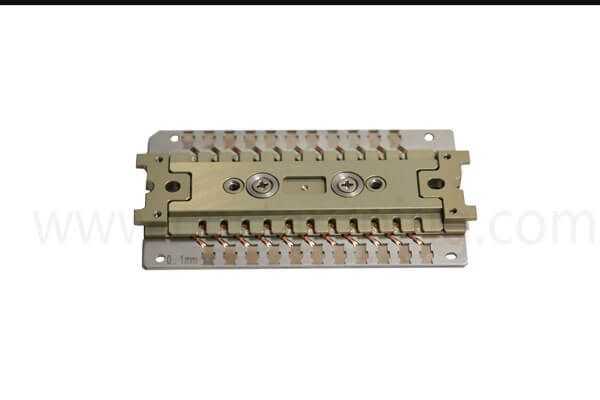
A central spine (the carrier) with multiple flexible fingers or blades branching out sideways like ribs. Is each finger a precision machined beryllium copper or tungsten contact that lands on a specific pad of the COC substrate.
Unlike pogo pins, which apply force axially, these fingers use a spring like cantilever action. They press down on the pads with a controlled, repeatable normal force — typically 15 to 25 grams per contact. The “bone” structure also leaves open spaces between fingers, which is key for airflow and temperature uniformity.
How COC Burn-in Fishbone Fixture Actually Empower Reliability Screening
Thermal Uniformity – No More “Hot Corners”
During burn-in, the chip itself is the heat source. But if your fixture creates local thermal resistance variations, some chips run hotter than others, then your screening loses statistical meaning.
Fishbone fixtures solve this in two ways:
- The open-frame design allows forced convection (air or nitrogen) to flow freely around every COC.
- The contact fingers are thin and made of high thermal conductivity alloys. They do conduct enough heat away from the bond pads to prevent localized hot spots.
Contact Resistance Stability – The Silent Killer of Aging Data
As the fixture heats up, pogo pins oxidize, springs lose tension, and oxides form on the pad surface. Resistance creeps up by milliohms, and that small change alters the bias current applied to the laser.
Fishbone fingers, on the other hand, use a wiping action. When you load the COC, the angled tip slides across the gold pad, breaking through any native oxide and creating a gas-tight junction. And because the finger has a long elastic travel (typically 0.3- 0.5 mm), it maintains a constant force even as thermal expansion moves the carrier or the board bows.
High-Density Parallel Testing Without Crosstalk
Modern COCs are tiny. To be cost-effective, you need to burn in 64, 128, or even 256 devices simultaneously on a single temperature controlled platen. But dense arrays create two problems: electrical crosstalk (adjacent signals coupling) and mechanical interference (loading/unloading jams).
The fishbone layout naturally separates each contact site with air gaps. You can route separate sense and force lines (Kelvin connections) through the wide spine without crowding. And because the fingers are individually compliant, a slight misalignment of one COC doesn’t affect its neighbor.
Easy Loading – Less Operator Fatigue, Less Broken COCs
COCs are often handled with vacuum tweezers and placed into a socket with a top clamp or a sliding lid. Operators hate it.
Fishbone fixtures typically use a simple drop in placement, guided by precision alignment pins, with no additional clamping. The fingers themselves provide the holding force from the top. To unload, you pry gently with a plastic tool—no screws, no springs popping out.
For a 128 site burn-in board, that’s almost an hour saved per batch. And more importantly, the operator induced damage rate drops to near zero.
A Tool That Fits the Demands of Current Reliability
If you’re doing COC laser chip reliability screening for 5G front? haul transceivers, LiDAR emitters, or automotive LiDAR arrays, the fishbone fixture is your best choice. It lets you:
- Run longer burn-ins with stable contact resistance.
- Achieve tight thermal control across the entire board.
- Scale from engineering validation to high volume production without redesigning the contactor.
- Reduce operator errors and increase first pass yield.
Need a Fishbone Fixture for Your Next COC Burn-In