
Why Fishbone Fixtures Are the Gold Standard for CoC Burn-in Systems?
If you’re still using conventional contactors for COC (Chip‑on‑Carrier) burn‑in, this artical will tell you why fishbone fixtures in CoC burn‑in systems are necessity for any reliability lab.
What Exactly Is a COC Burn-in System, and Why Is It So Demanding?
Before we dive into the fixture, let’s set the stage. A COC is a bare laser diode or photodiode mounted onto a small ceramic or silicon submount, with fan-out electrodes for easy probing and wire bonding. It’s the workhorse of modern optical transceivers, LiDAR, and high-speed data communication. During burn-in (or aging), these devices will be used at elevated temperature (typically 85°C to 125°C) and nominal operating current for tens to hundreds of hours to accelerate early failures and weed out infant mortality parts before they reach the customer.
The system itself features a platform capable of accommodating multiple device carriers. Each carrier has dozens of sockets for mounting COCs, and each socket meets the following requirements:
- Low and stable electrical contact resistance
- Excellent thermal coupling performance with the platform and environment
- Simple operation, avoiding damage to the fragile ceramic carrier
- High density, free from crosstalk or mechanical interference
Conventional sockets such as pogo pins, elastomeric connectors, or simple spring clips were never designed for this triple threat. They will oxidize and lose spring force at high temperatures, and even create hot spots. However, the fishbone structure can solve those problems.
The Fishbone Difference – What Makes This Fixture So Special?
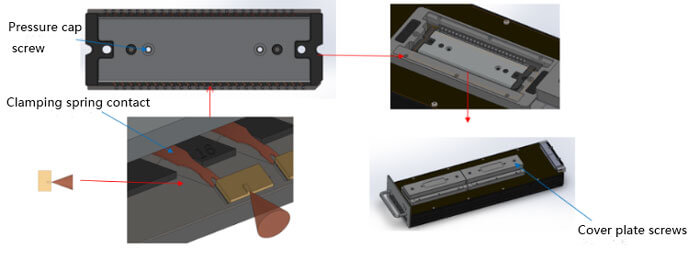
Look at one from above, and you’ll see the inspiration: a central “spine” with thin, flexible “ribs” branching outwards. Each rib is a precision-machined beryllium-copper (or nickel-cobalt alloy) finger that ends in a pointed tip. The tips land on the gold pads of your COC, and the fingers are cantilevered to provide a consistent contact force.That simple geometry unlocks four huge advantages over legacy designs.
Rock-Stable Contact Resistance Under Heat
Pogo pins rely on a compressed spring inside a barrel. At 85°C, that spring loses 10-15% of its force. At 125°C, it’s even worse. The contact resistance drifts upward, and your constant-current source ends up delivering less current than intended – because the driver sees the total loop resistance, not just the chip.
A fishbone finger, however, is a cantilever beam. Its deflection is purely elastic, and the material (beryllium copper) retains its modulus up to 200°C. The force stays constant over the entire temperature range. Moreover, the tip has a slight wipe motion during insertion, which shears through any oxide film on the gold pad.
Thermal Uniformity, Not “Hot Corners”
Ever notice that the corner sites on your aging board always seem to fail more often? That’s because plastic or dense metallic blocks trap heat. The corners run colder or hotter than the center, and your junction temperature is never what you set.
The fishbone open frame construction leaves large air gaps between the fingers. When the chamber circulates nitrogen or clean, dry air, that gas flows straight through the fixture, bathing every COC in the same temperature. The thin fingers add negligible thermal mass, so they don’t sink heat away from the chip. And the ceramic submount sits directly against the heater platen underneath, giving you a short, consistent thermal path.
Loading That Won’t Break Your Expensive COCs
COCs are fragile. Their ceramic carriers can crack under uneven pressure, and sloppy clamps easily crush the wire bonds. Traditional sockets often use screw-down lids or sliding covers that require a “feel” for the right torque – and operators, being human, mess it up.
The COC fishbone clamp is secured by multiple locating pins. Simply press down, and the spring force of the jaws can firmly clamp the equipment without the need for additional pressure points.
High-Density Layout Without Cross-Talk
As the number of channels increases, the risks of electromagnetic interference and mechanical congestion also increase. The fishbone design naturally separates signal lines.
Hejustamping-Your Faithfully COC Fishbone Fixtures in Burn-in System Supplier
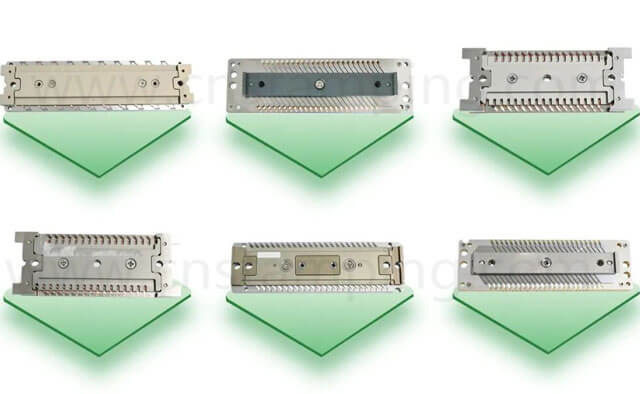
As a high-tech enterprise specializing in the R&D, design, and mass production of fishbone fixtures in COC burn-in system, Heju Precision’s self-developed COC fishbone fixture boasts mature technology and stable quality control. Relying on 8years of mass production experience in supplying beryllium copper spring sheets to Huawei, it features outstanding high-temperature thermal conductivity and clamping performance.
It is precisely matched to the harsh working conditions of long-term power-on aging tests for optical communication lasers, perfectly solving industry pain points such as poor heat dissipation, cumbersome assembly, high maintenance costs, long delivery cycles, and weak equipment compatibility of traditional fixtures. With its precision manufacturing capabilities, it provides reliable support for optical communication chip manufacturers to efficiently complete quality screening and control chip yield. Contact us for your burn-in testing project.