
An In-Depth Analysis of the Roll-to-Roll Terminal Stamping Process
Last week, a purchasing manager called me. His automated crimping applicator kept jamming. The culprit? A reel of female terminals that looked fine on the outside but had a slight twist in the carrier strip. That tiny twist shut down a line making a thousand harnesses an hour.
He bought from a supplier who gave him a rock-bottom price. But the cheap part stopped the expensive machine.
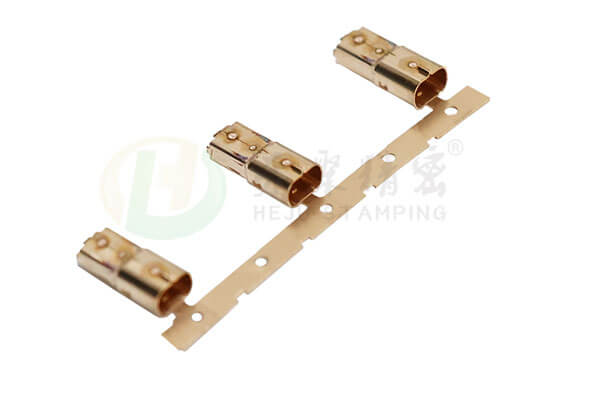
Look at the picture above. It’s a classic bullet-style female receptacle on a carrier strip—the kind we stamp every day at Heju. If you are sourcing custom female terminal stamping, this picture shows exactly what you need to inspect before placing an order. It looks like a simple folded piece of brass, but every curve has a job to do.
The Flared Mouth: It’s Not Just for Looks
Look at the wide, trumpet-like opening at the front of the terminal. That is your first line of defense against production jams.
When a male pin comes in slightly off-center during automated assembly, this flared lead-in chamfer guides it into the barrel. If the stamping die leaves a rough burr on that edge, or if the angle is inconsistent, the pin hits the flat face. It bends the terminal, and the line stops.
In our progressive dies, we control that entry angle tightly. It is a millimeter detail that separates a smooth-running line from a scrap bin full of bent pins.
The Physics of Contact Force Inside the Barrel
You can see stamped indentations on the side of the barrel. These hold the internal leaf spring in place.
As a copper alloy terminal stamping supplier, we know that the spring force inside that barrel is everything. Too weak, and the connection fails vibration tests. Too stiff, and your operators can’t click the connector into place.
To get it right, you need the correct temper of phosphor bronze or beryllium copper, and a die that forms the spring consistently. You cannot fix bad stamping by bending the part later. The physics is set during the stamping process.
The Carrier Strip is a Precision Part
This might be the most overlooked part of the image. See that long metal strip with the pilot holes?
For reel-to-reel metal stamping, the carrier strip dictates how the terminal feeds through the plating bath and how it sits in your applicator. If the pitch (the distance between terminals) is off, or if the strip isn’t perfectly flat, the reel will jam.
We treat the carrier strip with the same tight tolerances as the contact area. A perfectly stamped terminal is useless if the reel won’t feed.
Plating Starts with a Clean Stamping
These terminals are usually post-plated in tin or gold. If the stamping process leaves heavy burrs or folds inside the barrel, the plating won’t cover them.
During the insertion process, the insertion pins will scrape off the tin coating, thereby exposing the underlying metal. A few months of thermal cycling later, oxidation sets in, and you have intermittent electrical failures. Therefore, a clean stamping process is the foundation of a reliable plated part.
Why Sourcing the Automotive Connector Terminal Factory Matters
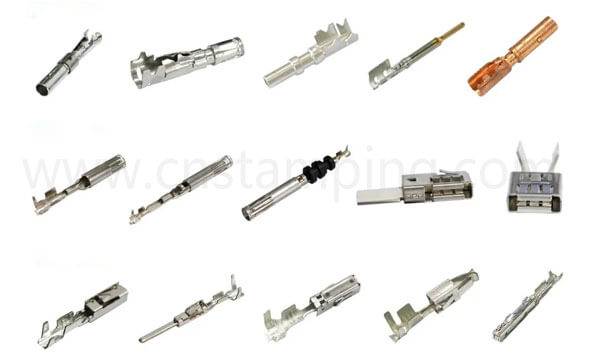
If you’re looking for a bullet receptacle terminal manufacturer or a reliable automotive connector terminal factory, don’t just look at the unit price. Look at the tooling expertise behind it. At Heju Stamping, we design and build our own progressive dies in-house. When your line has a jam, we can actually adjust the die parameters to fix the root cause. We don’t just ship boxes of parts; we make sure they run smoothly in your applicator. If you have a drawing, send it over. Our engineering team will look at the material, the tolerances, and the annual volume to give you an honest assessment of tooling feasibility.