
A Guide to Avoiding Pitfalls When Purchasing Press-Fit Terminals
I’ve been in automotive electronics procurement for nearly thirty years. When it comes to press-fit terminals—specifically the “eye-of-the-needle” type—they might look identical on the surface, and prices can vary by two or three times. Once they are mounted on a board and subjected to thermal cycling, the real differences become apparent. Today, I’d like to share the pitfalls I’ve encountered, my experiences dealing with suppliers, and the kind of details you won’t find in the specifications.
What Kind of Press-fit Connectors Customers Want?
When handling orders, foreign trade sales representatives often receive requests where the client simply specifies “press-fit terminal” and provides a drawing or sample. However, there are vast differences between various types of press-fit terminals.
We can divide automotive press-fit terminals into at least three categories based on application:
- Signal Terminals
0.64mm thick, paired with a 1.016mm hole diameter; while insertion/extraction force requirements are modest, contact resistance must remain stable. These are frequently used in ADAS cameras and radar modules.
- Power Terminals
0.81mm or even 1.0mm thick, paired with a 1.486mm (or larger) hole diameter; Designed to carry currents of several tens of amperes. Common in OBCs, DC-DC converters, and BMS main circuits.
- High-current Terminals
Made of CuCrZr alloy with conductivity exceeding 80% IACS; Some require silver plating. Used in charging pile modules and inverters.
If you quote for power terminals using pricing intended for signal terminals, the discrepancy will be exposed the moment the client tests the insertion force. Therefore, the first step upon receiving an inquiry is to clarify the application scenario, current rating, and hole dimensions—do not rush to provide a quote.
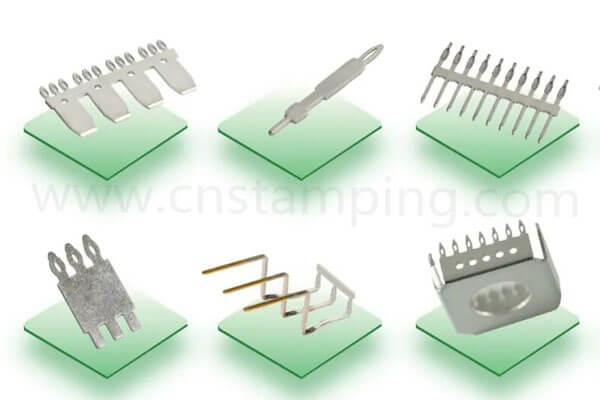
The Hidden Issues with Plating of Press-fit Pins
The core competitive advantage of press-fit terminals lies in their plating. While they may all appear to be “tin-plated,” the actual manufacturing processes vary significantly.
In the past, a common industry problem was that the surface tin layer would be scraped off during the press-fit process; the resulting debris would remain inside the hole, causing short circuits. Later, a patented technology was introduced that involves alloying the tin over a nickel underlayer. This creates a structure where a very thin layer of unalloyed tin remains on the surface to reduce insertion force, while the underlying alloy is harder than the copper lining of the hole—meaning any scraping occurs primarily on the copper rather than the terminal’s plating. This process has now become the standard for high-end press-fit terminals.
However, some low-cost suppliers simply plate with pure tin. Although they may specify a high plating thickness, the coating gets badly scraped off during the press-fit operation. If customers lack technical knowledge and focus solely on price, the result can be a recall of the entire batch when failures occur.
Hole Diameter Tolerance: The Make-or-Break Factor for Press-Fit
Unlike soldering—which offers some margin for error regarding the amount of paste used—press-fit technology relies on a physical interference fit. If hole diameter tolerances aren’t tightly controlled, the insertion force will be either too high (risking board fracture) or too low (resulting in poor electrical contact).
For customers using press-fit terminals, it is essential to strict oversight of the PCB manufacturer. I recall a case where a customer switched to a cheaper PCB supplier that relaxed the hole diameter tolerance from ±0.05 to ±0.1; However, the compliant press-fit pins exhibited only half the required retention force and failed vibration testing outright.
In Conclusion
When selecting a pressfit terminal supplier, look beyond the terminal itself. Ask if they possess FEA simulation capabilities and can generate stress analysis reports based on your specific board material, copper thickness, and hole diameter. A supplier with these capabilities is worth the higher price.
The technical barrier for press-fit terminals is higher than many people realize. When selecting a supplier, don’t just look at the price quote; see if they can discuss details like plating processes, hole-size matching, and FEA simulations with you in depth.
I hope you find this information useful. If you are currently looking for a press-fit terminal supplier or are unsure about any technical details, feel free to reach out.