
When Cheep Automotive High-Voltage Connector Terminals Meet Thermal Runaway
If you’ve ever been in a harness plant when a 400V or 800V connector melts down on the test bench, you know the smell.
It’s a mix of burning silicone and scorched copper. And it usually happens for one of two reasons: a poorly designed crimp, or an automotive high-voltage connector terminal that simply couldn’t handle the current without giving up its spring force.
Here is what actually matters when you are qualifying a supplier for high-voltage connector terminals.
Stress Relaxation
The contact spring inside a female high-voltage terminal is a piece of copper alloy that is bent into shape to press against a male pin. The pressure it exerts is called “normal force.”
When 300 or 400 amps flow through that joint, the metal gets hot. Under constant heat and constant stress, copper alloys have a nasty habit: they slowly lose their elasticity. This is called stress relaxation.
If your supplier uses cheap brass instead of a proper high-performance copper alloy—like beryllium copper or specialized high-conductivity tempers—the spring will relax. The normal force drops, contact resistance jumps, the joint gets hotter, and the spring relaxes even faster. It’s a thermal spiral that ends in a melted connector.
When you’re sourcing an EV battery connector terminal, don’t just ask for the material name. Ask for the stress relaxation data at your specific operating temperature. If the copper alloy terminal manufacturer can’t provide it, they are guessing.
Sealing O-Ring
Take a look at any sealed high-voltage terminal. You’ll see a black silicone sleeve with multiple ribs.
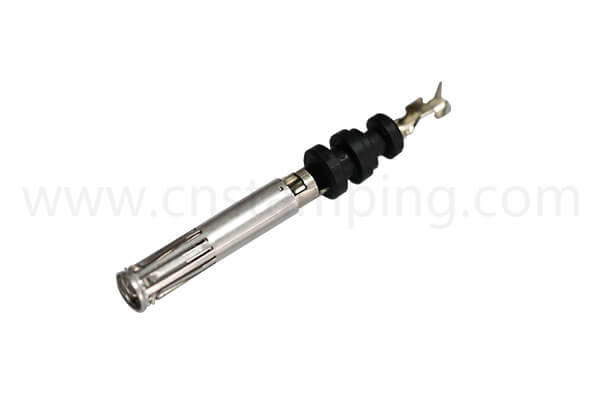 Customers often assume this is merely a standard component that can just as easily be installed later. In reality, that is not the case. The sealing performance of this terminal depends entirely on the precise outer diameter (OD) and roundness of its stamped barrel.
If the high current terminal stamping barrel deviates from a perfect circular shape during the stamping process, or if an uneven seam forms where the metal is folded, the silicone sealing ring will not be subjected to uniform compression. Although the product may pass IP67 ingress protection testing at the time of manufacture, its sealing performance could be compromised during subsequent thermal cycling—when plastic components undergo deformation due to thermal expansion and contraction. Once moisture enters the high-voltage connection area, it can lead to electrical leakage (tracking) and arcing.
High-quality stamping dies can keep the deviation in the outer diameter of a cylindrical component within a small fraction of a millimeter, thereby ensuring that seals can fully perform their intended design functions.
The Plating Problem
High-voltage terminals are almost always silver-plated to ensure optimal electrical conductivity and minimize contact resistance.
However, the silver plating layer is extremely thin. If the stamping process leaves deep scratches, noticeable burrs, or creases inside the cylinder, the plating will be unable to cover them. During assembly, the male pin will rub against these rough surfaces, wearing through the thin silver layer and exposing the underlying copper substrate. Within a few weeks, copper oxide will form, leading to increased electrical resistance and, consequently, intermittent malfunctions.
A high-quality reel-to-reel terminal stamping line prioritizes surface integrity. We meticulously maintain our progressive dies, as the silver plating can only perform its intended function effectively when the metal surface remains pristine.
Reel-to-Reel Feeding: The Hidden Cost of Bad Tolerances
On a terminal assembly production line, the theoretical physics behind the terminals is of little concern; what matters is whether the coiled strip can be fed smoothly into the crimping equipment at a rate of 3,000 pieces per hour.
The carrier strip must be perfectly flat, and the pitch must be precise. Any twisting in the strip or the slightest deviation in the positioning of the pilot holes will cause the crimping equipment to jam.
At Heju, we apply the same rigorous precision standards to our stamped terminal carrier strips as we do to the terminal contact areas themselves. After all, if a production line has to be shut down every twenty minutes to clear a jam, even the most perfectly designed contact interface becomes meaningless.
HejuStamping-Reliable Automotive Connector Terminals Supplier
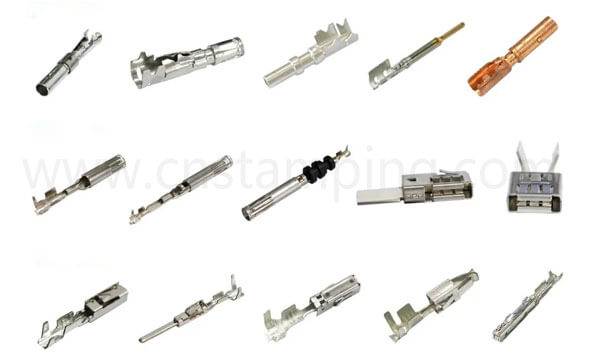
Finding an automotive high-voltage connector terminal supplier in Asia isn’t hard. Finding one that understands the physics of the connection is.
At Heju Precision, we’ve been stamping precision terminals for the automotive industry since 2006. The company has held IATF 16949 quality management system certification. It possesses comprehensive end-to-end capabilities—spanning from mold design and manufacturing to final product delivery—and has established a robust quality inspection system to ensure consistency throughout the entire process.
If you have a drawing, send it over. Our engineering team will look at the material, the tolerances, and your volume, and give you a straight answer on whether we can build a die that keeps your EV line running.